

Typical household energy costs will fall on 1 April 2026 when the new energy price cap takes effect, after a change to the way charges are calculated.
It follows a government pledge in the Budget to remove some costs from annual energy bills, and means a typical household will save around £117.
However, the cost of maintaining the energy network’s infrastructure has gone up, which means households will save less than the government initially suggested.
Bills could also rise sharply this summer due to the jump in oil prices since the beginning of the US-Israeli war with Iran.
What is the energy cap and how is it changing?
The energy cap covers around 19 million households in England, Wales and Scotland and is set by Ofgem every three months.
It fixes the maximum amount customers can be charged for each unit of gas and electricity on a standard – or default – variable tariff for a typical dual-fuel household which pays by direct debit.
Actual bills depend on the amount of energy used.
Between 1 April and 30 June 2026, the annual bill for dual-fuel direct debit households in Great Britain using a typical amount of energy will be £1,641.
That is a fall of £117 a year, or 7%, from the previous cap which applied between January to March. However prices are still about a third higher than they were before the war in Ukraine.
During the three-month period, gas prices are capped at 5.74p per kilowatt hour (kWh) and electricity at 24.67p per kWh.
Ofgem regulates the energy market in England, Scotland and Wales. Northern Ireland has a separate system.
The regulator will announce the next energy price cap change on 27 May 2026. The level of that cap will be determined by what happens between now and May on the wholesale energy market. If the price of oil remains elevated, it could leave consumers facing significantly higher bills.
What is a typical household?
The price cap sets the unit prices for gas and electricity, but your household’s actual bill depends on the overall amount you use, and how you pay for it.
The type of property you live in, how energy efficient it is, how many people live there and the weather all make a difference.
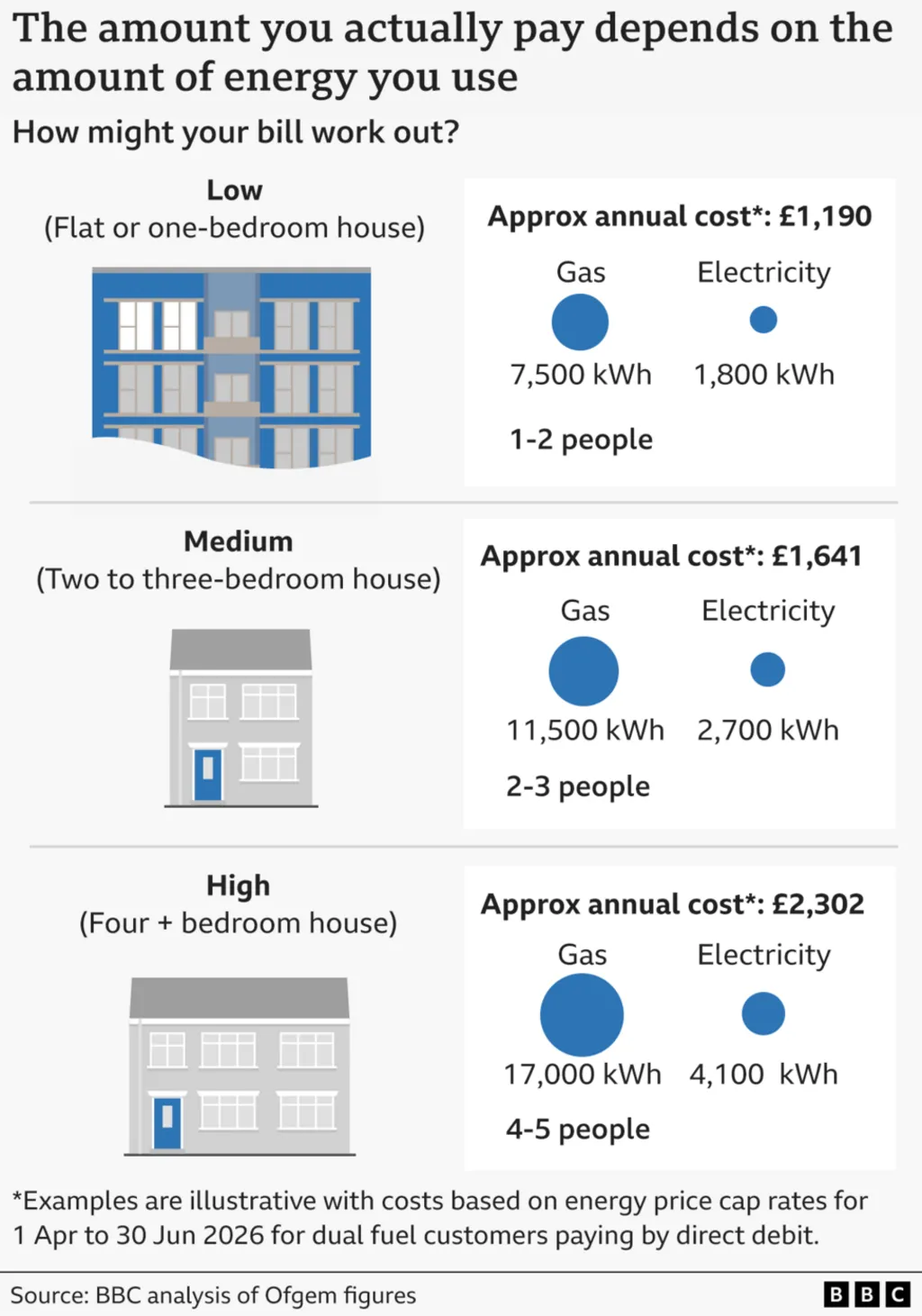
The Ofgem cap is based on a “typical household” using 11,500 kWh of gas and 2,700 kWh of electricity a year with a single bill for gas and electricity, settled by direct debit.
The vast majority of people pay their bill this way to help spread payments across the year. Those who pay every three months by cash or cheque are charged more.
How has the way energy bills are calculated changed?
In the November Budget, Chancellor Rachel Reeves announced measures to cut energy costs from April 2026.
From 1 April, charges related to the insulation scheme – called the Energy Company Obligation – will be scrapped, and for three years, renewable energy projects will be 75%-funded by general taxation instead of a levy on energy bills.
Prior to the changes, energy bills in England, Scotland and Wales included additional charges to help fund insulation for low-income households, and subsidise green energy projects such as wind farms and solar panels.
Nearly everyone in England, Wales and Scotland will benefit from this cut whichever energy tariff they are on, although the amounts will vary between households.
However, at the same, the cost of maintaining and strengthening energy network infrastructure like power lines, cables and gas pipes is rising.
In December, Ofgem said it had approved a £28bn investment to improve the electricity and gas grids in Great Britain.
It said this will strengthen the energy supply, and better shield customers from volatile energy prices. It will also reduce Britain’s dependence on gas.
Customers will pay part of the cost of the upgrade, through an additional £108 added to energy bills by 2031.
These charges will also start to appear from April 2026, adding about £6 a month to the bill for a typical household covered by the energy cap.
That means that although Reeves had initially said the changes would take £150 off average annual dual-fuel bills, typical households will actually save £117.