The Hidden Driver of SME Energy Costs Most Businesses Misunderstand
Most businesses assume their electricity bill is determined by how much energy they consume.
That assumption is only partially correct. In reality, many commercial energy bills are not driven by total consumption — but by how and when energy is consumed. This is where peak demand charges come in.
At SAEK Energy, we often find that peak demand — not total usage — is the primary reason energy costs remain high even after efficiency improvements or solar installations.
What is Peak Demand?
Peak demand refers to:
the highest level of electricity usage recorded during a specific billing period (usually measured in kW or kVA). It is not about total energy used. It is about the single highest spike in power demand.
This spike can last:
• a few seconds
• a few minutes
• or a short operational window
But it has a disproportionate impact on cost.
Why Peak Demand Costs Matter So Much
Electricity providers charge for peak demand because it determines:
•infrastructure capacity requirements
•grid stability planning
•supply risk management
Even if your peak lasts only a short time:
it defines your billing baseline for the entire period
This means:
•one short spike can increase your entire monthly bill
•even if overall consumption remains stable
The Most Common Misconception
Many businesses believe:
“If I reduce energy usage, my bill will go down proportionally.” This is incorrect in demand-based billing systems.
You can reduce:
•total kWh usage
•operational runtime
•equipment energy efficiency
And still see minimal bill reduction if:
peak demand remains unchanged
What Actually Creates Peak Demand Spikes
Peak demand is usually not caused by one large system running continuously.
It is caused by simultaneous load clustering, such as:
•multiple machines starting at the same time
•HVAC systems activating together
•production lines restarting after downtime
•compressors or pumps engaging simultaneously
These short overlaps create:
disproportionate cost spikes
Why Solar Alone Does Not Solve Peak Demand
A common misconception in energy planning is:
solar automatically reduces electricity costs
Solar reduces energy consumption (kWh),
but it does not necessarily reduce peak demand (kW).
If peak demand occurs:
•early morning
•during startup cycles
•or outside solar generation windows
Then solar has:
little to no impact on demand charges. This is why many solar installations deliver lower savings than expected.
The Critical Link Between Peak Demand and Battery Systems
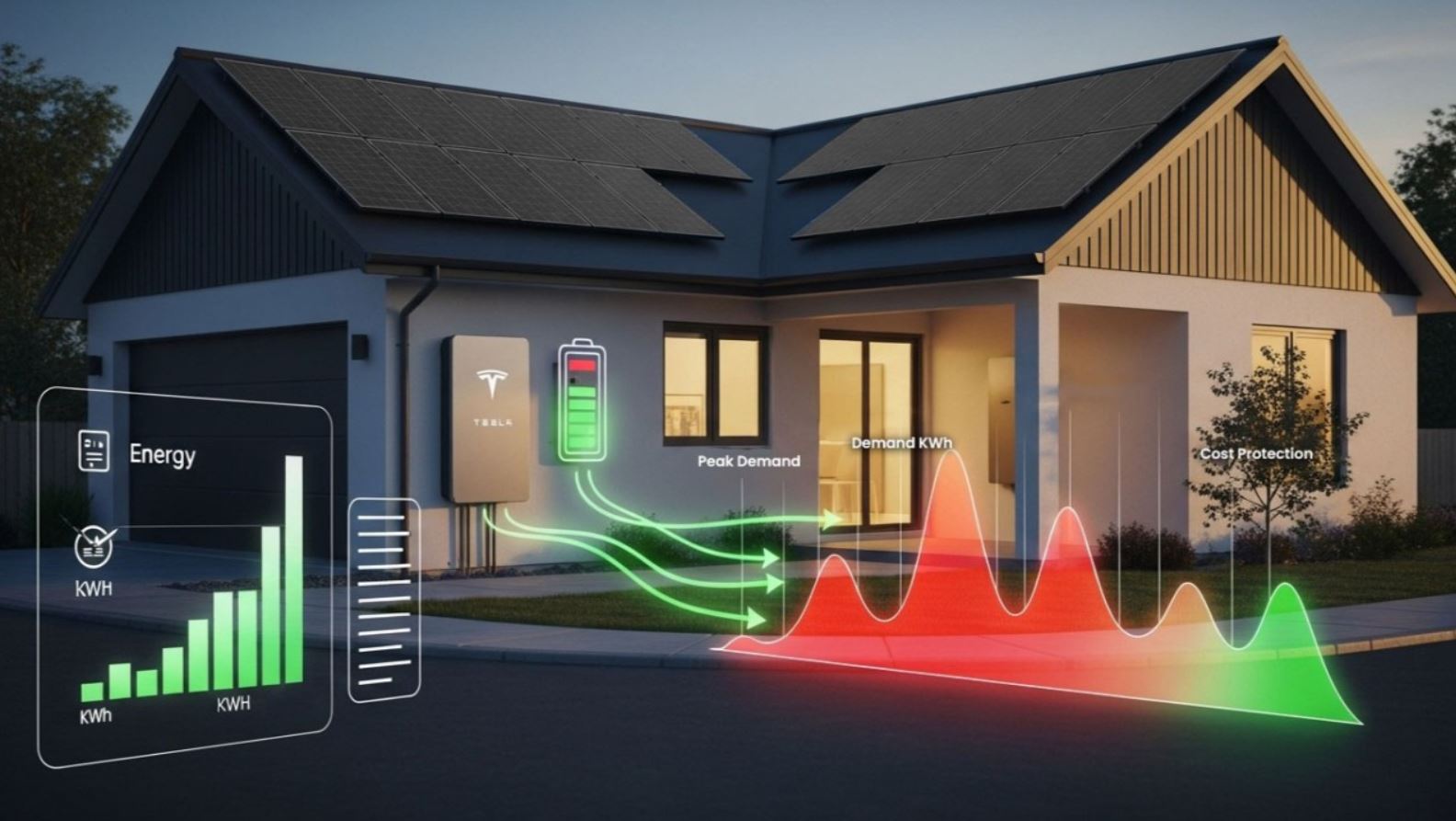
Battery systems become relevant when peak demand is understood correctly.
Their real function is not:
•backup power
•energy storage alone
But:
peak shaving (reducing short-term demand spikes)
A properly designed battery:
•discharges during load spikes
•smooths operational surges
•reduces grid-import peaks
However, if the battery is incorrectly sized or poorly controlled:
•peak demand remains unchanged
•ROI drops significantly
•system appears underperforming
Why SMEs Are Most Affected
Small and medium enterprises are particularly exposed because:
• equipment is often manually operated
• processes are not staggered
• automation is limited
• energy planning is rarely integrated into operations
This creates:
highly irregular and unpredictable demand spikes
As a result:
• energy bills fluctuate heavily
• cost predictability becomes difficult
• efficiency upgrades show limited impact
The Hidden Problem: Operational Timing
Peak demand is rarely an energy problem. It is an operational timing problem.
Examples:
• machines starting together instead of sequentially
• production schedules not aligned with energy cost structure
• HVAC systems running during non-optimal load windows
This means:
energy cost is often driven by behaviour, not consumption
How Peak Demand Should Be Managed
Effective peak demand management requires:
1. Load profiling
Understanding exactly when spikes occur.
2. Load staggering
Preventing simultaneous high-energy operations.
3. Peak shaving systems
Using batteries or hybrid systems strategically.
4. Operational redesign
Aligning production schedules with energy cost structure.
Why This Matters for Solar and Hybrid Systems
Peak demand is one of the most important inputs in:
• solar feasibility design
• battery sizing decisions
• hybrid system architecture
• ROI calculations
Without understanding peak demand:
system design becomes guesswork based on energy averages
With it:
systems become engineered for actual cost reduction
Conclusion
Peak demand is not an energy consumption issue. It is a system behaviour issue that directly determines cost structure. Most businesses do not have high energy costs because they use too much electricity. They have high costs because they use electricity at the wrong time, in the wrong configuration.